Homework 2
BECO 3310 | Part 2: Markets & the Firm
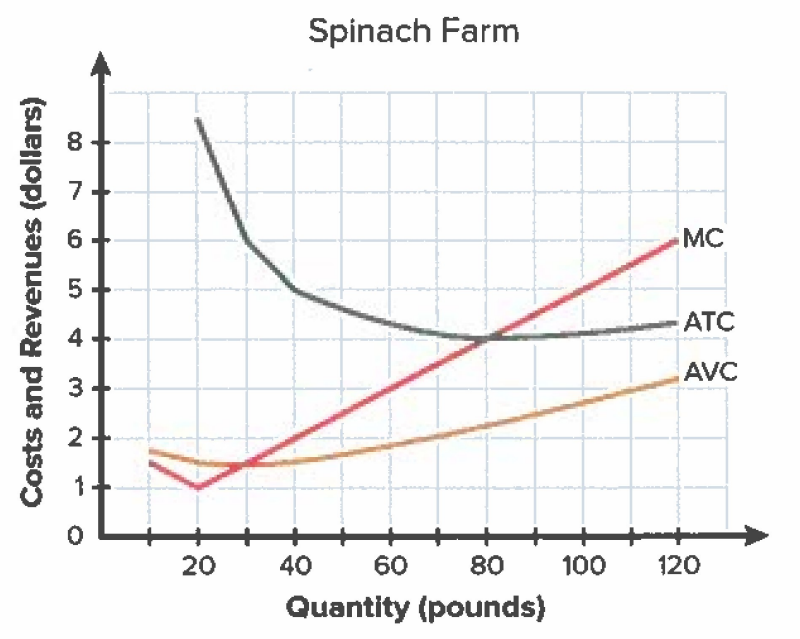
Figure 1
Figure 1 shows the cost curves for an individual spinach farm.
1. Refer to Figure 1 above: If the market price for spinach is $3, should the farm continue to produce in the short-run? Intuitively explain why or why not.
2. Refer to Figure 1 above: If the market price for spinach is $5, should the farm continue to produce in the short-run? Intuitively explain why or why not.
3. Refer to Figure 1 above: If the market price for spinach is $4, should the farm continue to produce in the short-run? Intuitively explain why or why not.
4. List the four assumptions of the perfectly competitive market.
5. Intuitively explain why competitive firms choose the quantity that maximizes profit.
6. Suppose last year you opened a bakery. You had $90,000 in explicit costs which included wages to your employees, equipment and rent for the bakery, and the costs of ingredients. You also incurred $61,000 in implicit costs, including the $60,000/year salary you earned at your previous job. Over the course of the year, you sold 20,000 baked goods at an average price of $10 each.
- What were your accounting profits last year?
- What were your economic profits last year?
7. Intuitively explain why running shoes are not a standardized, or homogenous, product and inappropriate to be used as an example in the perfectly competitive market model.